.png?width=400&height=30&name=beckhoff_logo_nat_white%20with%20tagline%20(transparent).png "beckhoff_logo_nat_white with tagline (transparent)")
How to Maximize EtherCAT - Only with Beckhoff
.png?width=76&height=76&name=Untitled%20(100%20x%20100%20px).png "Untitled (100 x 100 px)")
%20(500%20x%20500%20px).png?width=700&height=700&name=Untitled%20(100%20x%20100%20px)%20(500%20x%20500%20px).png "Untitled (100 x 100 px) (500 x 500 px)")
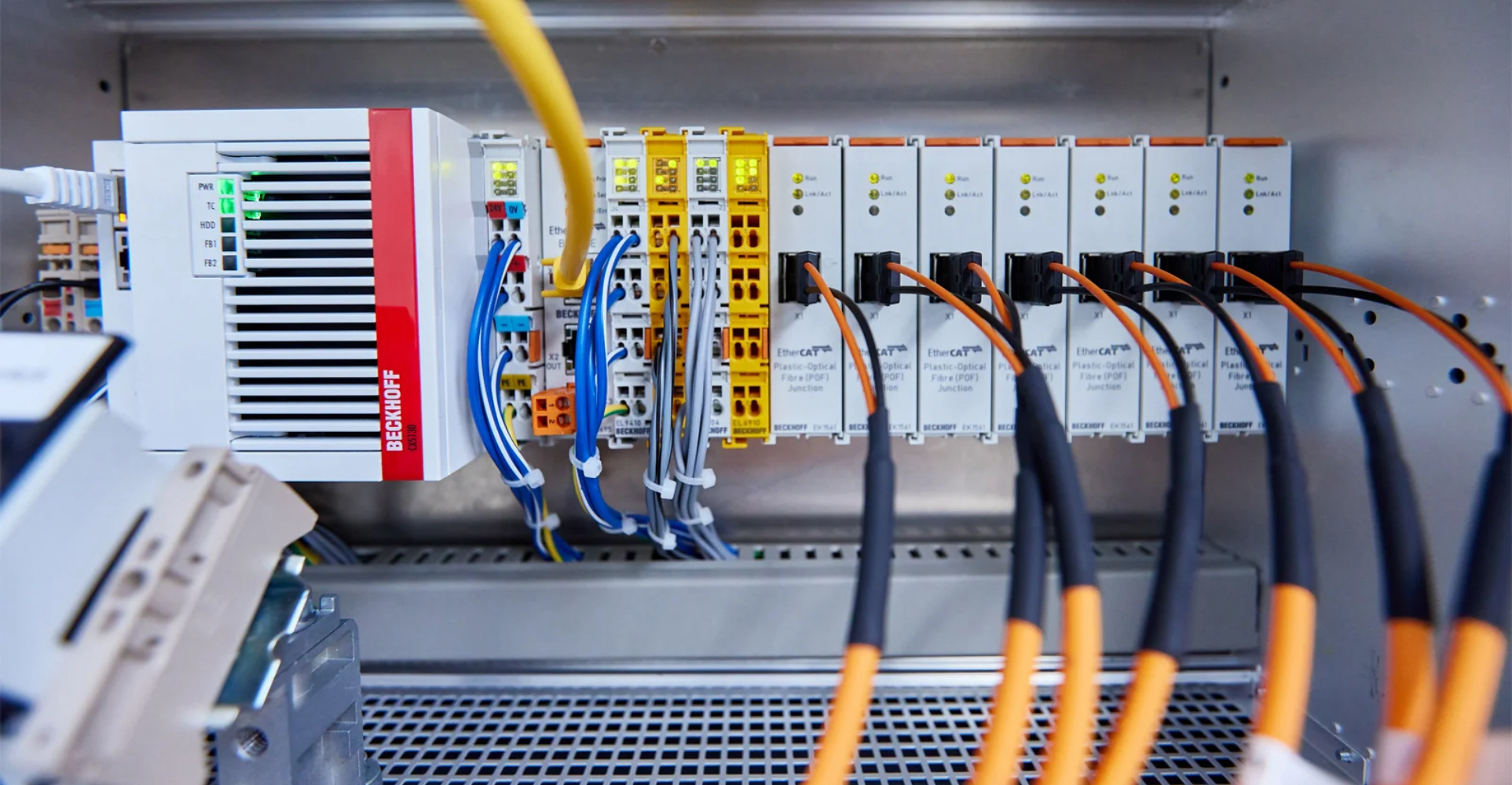
EtherCAT is one of the most powerful industrial Ethernet technologies available, but not all EtherCAT implementations are created equal. The difference lies in how the system is designed, integrated, and supported.
Beckhoff isn't just an adopter of EtherCAT. We invented it. That deep integration gives us the control, optimization, and flexibility across hardware and software that third-party systems simply can’t match.
To learn more about the practical advantages manufacturers gain when using Beckhoff's EtherCAT implementation, we spoke with Jim Fallowfield, Senior Business Development Manager at Beckhoff.
Save Space and Installation Time with Ultra-Compact Modular Hardware
Control cabinet space is limited, and traditional I/O systems take up more than their share. Beckhoff’s compact EtherCAT Terminals deliver more performance in a smaller footprint while simplifying installation and scaling.
The terminals feature a space-saving 12mm design that allows for dense signal packing without sacrificing functionality. Unlike competitor systems that require separate backplanes, mounting hardware, and interconnection components, Beckhoff's modular approach simplifies both installation and maintenance.
“Our terminals, they connect to each other. There's no need for extra hardware,” Fallowfield said, contrasting Beckhoff's system with a competitor's approach that requires backplanes and cartridges. “Our slices are all interconnected and very easy to swap in and out.”
This approach dramatically simplifies system architecture while expanding application possibilities. The result is faster installation, simpler maintenance, and significantly lower costs over the system lifecycle.
Beyond standard I/O, Beckhoff's specialized terminal types enable engineers to extend EtherCAT's capabilities into demanding applications:
- High-precision measurement terminals (ELMxxxx) for accurate data collection in laboratory and scientific applications
- Intrinsically safe terminals (ELXxxxx) for operation in explosive or hazardous environments
- Multiple signaling types on the same network without additional gateways or converters
.png "12 MM Beckhoff (2)")
Cut Engineering Hours with Automated Configuration
One of the most time-consuming aspects of traditional fieldbus implementation involves manual addressing and configuration. Engineers often spend hours setting DIP switches, managing addressing schemes, and troubleshooting configuration errors. Beckhoff eliminates these complications using TwinCAT automation software intelligent auto-configuration capabilities.
The software automatically scans and configures EtherCAT networks without requiring manual addressing or special cables. This automation extends to complex installations with hundreds or thousands of I/O points, maintaining the same simplicity regardless of scale.
“We just lay it out as it is. We then scan the network, and we're done,” Fallowfield said, explaining how TwinCAT handles network discovery. “And if I had 1,000 IO terminals, it would take about as long.”
Beyond initial configuration, TwinCAT's integrated diagnostic capabilities transform troubleshooting from a time-intensive process into a precise operation. Where other systems might require hours of manual investigation, Beckhoff's approach provides immediate fault localization.
“I pull up a screen, and I go, ‘Yeah, your problem is right here,’” Fallowfield said, adding that while working with other systems, he has “spent a day trying to track down where the problem was.”
This efficiency stems from EtherCAT's fundamental architecture.
“With EtherCAT, it's like a train going down the track, and everybody gets loaded on as it's going by. So, you don't have this scattering of signals going across the network; you have one specific large signal going across the network,” Fallowfield explained.
The software-driven approach eliminates potential human error in setup while providing engineers more time for value-added tasks rather than routine configuration work.
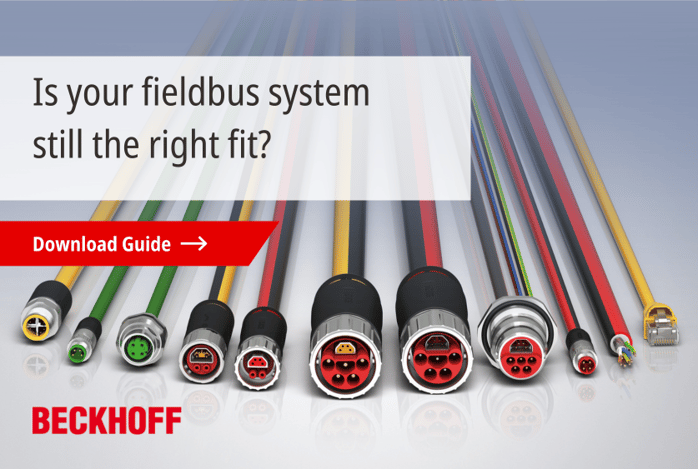
Protect Your Investment While Increasing Performance
Manufacturing facilities often contain a mix of automation technologies accumulated over years or decades. Rather than requiring complete system overhauls, Beckhoff's EtherCAT implementation works seamlessly with existing infrastructure through comprehensive protocol support.
Beckhoff's Bus Couplers enable EtherCAT networks to coexist with over 30 different protocols such as PROFIBUS, Modbus and CANopen.
“We can talk to every PLC manufacturer, collect and share information between systems, and even act as a top-level communicator,” Fallowfield said, explaining that this universal compatibility functions as a translator between different automation technologies, bringing enhanced performance to existing systems without requiring wholesale replacement.
What this means is that you can modernize your system without starting from scratch, keeping elements of your existing equipment while gaining next-level performance.
Beckhoff's software-based programming model provides additional investment protection by ensuring that hardware changes don't necessitate software rewrites. Engineers can modify physical configurations while maintaining existing code bases, protecting both hardware and software investments during system evolution.
Reduce Growth Barriers with Exceptional Scalability
Rack-based automation systems impose hard limits on expansion. Once a rack reaches capacity, engineers must add new hardware infrastructure, often requiring significant rewiring and reconfiguration. These constraints can limit business growth and create expensive scaling bottlenecks.
Beckhoff's EtherCAT implementation significantly reduces these barriers through its inherently scalable architecture. The system supports virtually unlimited expansion without the physical constraints that limit traditional approaches.
“Unlike rack-based systems, which can only put so many terminals on a rack before they're done, we have a limit of 65,000, which for practical purposes means we don't have a practical factory limit,” Fallowfield said, adding that the network architecture supports flexible topologies, including ring, star, and hybrid configurations. This flexibility enables engineers to design optimal layouts for specific applications and easily reconfigure systems for different production sequences without physical rewiring, all while maintaining software-based configuration throughout system growth.
In large facilities, where quick problem identification can significantly impact operations, this scalability becomes especially critical. In automotive manufacturing, for example, where extensive production lines or large distribution centers can span several acres, the ability to expand systems seamlessly while maintaining diagnostic precision provides substantial operational advantages.
Get Started With Beckhoff's EtherCAT Implementation
Beckhoff's deep integration with EtherCAT (from protocol development to hardware innovation and TwinCAT software) gives manufacturers a performance edge that third-party implementations simply cannot match.
Get in touch to discuss your industrial networking requirements and learn how Beckhoff's proven EtherCAT solutions can transform your manufacturing operations and efficiency.

You may also like:
.png "Intelligent Transport Systems in Life Sciences (1)")
.png "You may also like section (5)")
-1.png?width=273&height=21&name=beckhoff_logo_nat_white_a4-1%20(002)-1.png "beckhoff_logo_nat_white_a4-1 (002)-1")